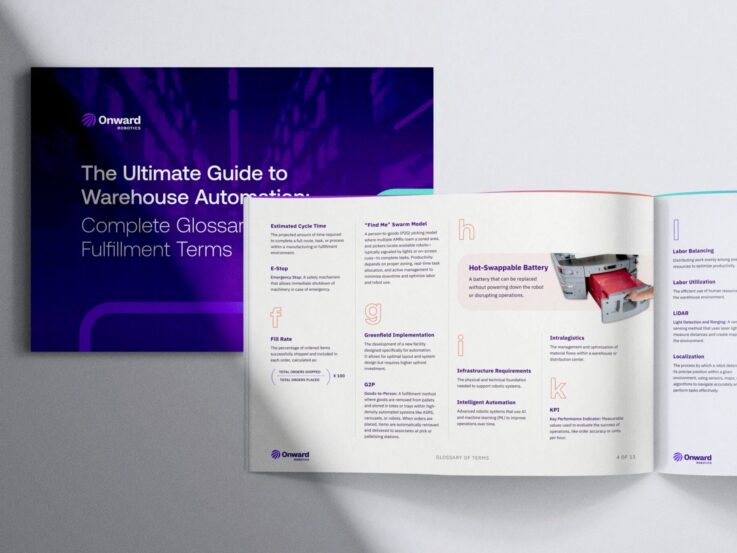
Complete Warehouse Automation Glossary
and Fulfillment Terms
Introduction
This warehouse automation glossary provides a comprehensive guide to essential terminology in fulfillment and warehousing. Understanding these terms is critical for maximizing operational efficiency and leveraging modern automation technology. The goal of effective warehouse management is to optimize processes using cutting-edge warehouse automation technology and systems.
Free Resource: The Complete Glossary of Fulfillment Terms
A
Advanced Algorithms
Sophisticated software that optimizes order fulfillment processes, including picking routes, order batching, and resource allocation.
AGV (Automated Guided Vehicle)
Robotic vehicles that follow predetermined paths in warehouses are typically guided by markers, wires, or sensors embedded in the floor. Along with other mobile robot solutions, automated guided vehicle technology is a foundational element of many operations.
Agile Automation
Flexible robotic systems that can quickly adapt to changing operational needs and order profiles.
AI (Artificial Intelligence)
Technology that enables systems to mimic human intelligence and improve decision-making over time. In automation, artificial intelligence adapts as it learns—optimizing tasks, routes, and performance without manual reprogramming.
Aisle Width Requirements
The minimum space needed between shelving or racking for robots and humans to operate effectively.
AMR (Autonomous Mobile Robot)
Self-navigating robots capable of moving independently throughout a facility, using sensors and software to navigate dynamically. These next-generation vehicles have largely replaced traditional automated guided vehicles in many modern facilities, with many companies deploying multiple autonomous mobile robots for flexible fulfillment.
API (Application Programming Interface)
A set of protocols allowing different software applications to communicate with each other, essential for warehouse system integration.
ASRS (Automated Storage and Retrieval System)
A high-density automated storage solution made up of tall racks with defined storage locations and one or more robotic retrieval units that move both vertically and horizontally along the system. Designed to maximize space utilization, this warehouse automation retrieval system automatically stores and retrieves items, typically using cranes, shuttles, or robotic arms.
Automation
Automation technology that performs tasks or processes with minimal human input, improving efficiency, accuracy, and consistency. An automated system is essential for meeting modern fulfillment demands.
Autonomous
Able to perform tasks or make decisions independently, without human intervention, typically using sensors, software, and real-time data. An autonomous robot leverages sensor data and on-board processing to operate safely and effectively.
B
Barcode Scanning
The process of using a handheld RF gun (radio frequency scanner) to read and decode information stored in a barcode, enabling quick identification, tracking, and management of products, materials, or inventory level changes.
Batch Picking (also known as multi order picking)
Enables workers to pick multiple SKUs from multiple orders at the same time. The orders are grouped into batches that include items in a batch and picks one SKU at a time for a batch of multiple orders.
Battery Swap
The process of replacing a depleted robot battery with a fully charged one, often done manually.
BOM (Bill of Materials)
A structured list of all the parts, materials, and components—often grouped in bundles—needed to manufacture a finished product. It outlines the quantities required for each item and serves as a blueprint for production and material handling planning.
Bottleneck
A point in the fulfillment process that limits throughput and causes delays.
Brownfield Implementation
The deployment of automation within an existing facility. It leverages current infrastructure and may involve integration with legacy systems and layouts.
C
CapEx (Capital Expenditure)
An investment in physical assets like robots or infrastructure that provides long-term value, typically contrasted with ongoing operational costs.
Click-to-Consumer Cycle Time
The total elapsed time from when a customer places an order online to when the order is successfully delivered to the customer. This metric captures the complete end to end fulfillment journey, encompassing order processing, warehouse operations, carrier handoff, transportation, and final delivery.
Cloud-Based Robotics
Refers to robotic systems that leverage cloud computing infrastructure to process data, manage operations, and receive software updates, rather than relying solely on on device computing. By connecting robots to centralized cloud platforms, these systems can offload compute intensive tasks such as data analysis, machine learning model execution, and fleet coordination, while enabling real time monitoring, remote control, and continuous improvement through over the air updates.
Cloud-Based Robotics supports greater scalability, faster deployment of new capabilities, and more coordinated behavior across distributed robot fleets, making it a foundational technology for modern automation environments.
Cluster Picking
Picking method where the picker will simultaneously pick various SKUs to complete multiple orders, working with a cart or an AMR that is loaded with a different tote or shipping container per order. Works best for small or medium-sized products.
Cost Per Order
The total cost incurred to fulfill a single customer order, including expenses related to receiving, storage, picking, packing, shipping, and returns. This metric provides a clear view of fulfillment efficiency and cost control across the order lifecycle. Lower Cost Per Order generally indicates more efficient operations and stronger unit economics.
Cycle Time
Measures the total time required to complete a specific operation or process from start to finish. It is used to evaluate operational efficiency, identify bottlenecks, and assess process consistency. Shorter cycle times typically reflect smoother workflows and higher throughput.
D
DC (Distribution Center)
A facility used for the receipt, storage, and distribution of goods within a logistics network. It serves as a central node where inventory is received, stored, picked, packed, and shipped to downstream locations or end customers. Distribution centers play a critical role in fulfillment speed, inventory availability, and transportation efficiency.
Decoupled Workflow Orchestration
Is the coordination of human and robotic activities as independent yet synchronized processes. By removing direct dependencies between people and robots, each can operate at optimal efficiency without waiting on the other. This approach increases system throughput, improves flexibility, and reduces reliance on traditional manual workflows.
Directed Workflow
Refers to systems that guide workers through specific tasks, sequences, and physical paths to maximize efficiency and accuracy. These systems often use software driven instructions delivered via mobile devices, scanners, or wearables. Directed workflows help reduce errors, improve productivity, and standardize operations.
Discrete Order Picking
Also known as single order picking, is a warehouse picking method where one worker picks all items for a single order from start to finish. Items are picked line by line until the order is complete, then packed and shipped. While simple to implement, this method can become inefficient at scale due to increased travel time.
Downtime
The period when equipment, systems, or processes are not operational and unable to perform productive work. Downtime may be planned or unplanned and often results in reduced throughput and lost productivity. Minimizing downtime is critical for maintaining operational efficiency.
Dwell Time
Measures the amount of time a robot or system remains idle or stationary rather than performing productive tasks. High dwell time can indicate inefficiencies in task allocation, workflow design, or system coordination. Reducing dwell time helps improve utilization and overall system performance.
E
Each Picking
Also known as piece picking or split case picking, is an order fulfillment method where individual items or SKUs are picked from larger cartons or storage locations. These items are typically combined with other SKUs to complete a customer order before packing and shipment. Each picking is common in ecommerce and retail fulfillment environments with high SKU variety.
E-commerce Fulfillment
The process of receiving, processing, and delivering orders placed through online sales channels. It includes inventory management, order processing, picking, packing, shipping, and returns. Efficient e-commerce fulfillment is critical for meeting delivery expectations and maintaining customer satisfaction.
Emergency Stop (E-Stop)
A safety mechanism designed to immediately halt machinery or automated systems in the event of an emergency. It allows operators to quickly stop operations to prevent injury or equipment damage. E Stops are a standard safety requirement in industrial and automated environments.
End-to-End Fulfillment
Refers to the complete flow of goods through a fulfillment operation, from order picking through packing, shipping, and delivery handoff. It provides a holistic view of how orders move through systems and processes. This perspective is often used to identify bottlenecks and improve overall operational performance.
Enterprise Resource Planning (ERP)
A software system that integrates and manages core business functions such as finance, inventory, production, and human resources within a single platform. It enables data consistency, operational visibility, and coordinated decision-making across the organization. ERP systems often serve as a primary source of record for centralized data warehouses and supply chain reporting.
Estimated Cycle Time
The projected amount of time required to complete a route, task, or process within a manufacturing or fulfillment environment. It is commonly used for planning, scheduling, and performance benchmarking. Comparing estimated versus actual cycle time helps identify inefficiencies and variability in operations.
F
Fill Rate
The percentage of ordered items that are successfully fulfilled and shipped to customers. It is calculated by dividing the total number of orders shipped by the total number of orders placed, then multiplying by 100. Fill rate is a key indicator of inventory availability, fulfillment accuracy, and customer satisfaction.
Fleet Management (Autonomous Mobile Robots)
Refers to the software-based coordination, monitoring, and optimization of multiple autonomous mobile robots (AMRs) operating within a facility. It includes task assignment, traffic control, charging management, congestion avoidance, and performance tracking. Effective fleet management ensures balanced workloads, minimized idle time, and maximum system throughput.
First Pass Yield (FPY)
The percentage of orders or order lines that are picked, processed, and completed the first time correctly without requiring rework, correction, or exception handling. It is calculated by dividing the number of error-free completions by the total number of attempts. High FPY indicates strong system accuracy, effective task orchestration, and minimal operational waste.
Floor-Level Localization
The ability of an autonomous mobile robot (AMR) to determine its precise position within a warehouse environment using onboard sensors such as LiDAR, cameras, or SLAM-based mapping systems. Accurate localization enables safe navigation, dynamic rerouting, obstacle avoidance, and precise positioning at pick stations. In high-density fulfillment environments, reliable floor-level localization is critical for maintaining throughput and preventing congestion.
Flow Optimization Engine
Refers to the software layer responsible for dynamically managing task sequencing, robot routing, labor assignment, and workload balancing within a warehouse automation system. By continuously analyzing order demand, inventory location, robot availability, and labor capacity, the engine minimizes idle time, reduces congestion, and maximizes system throughput.
“Find Me” Swarm Model
A person-to-goods picking approach in which multiple autonomous mobile robots operate within a zoned area, and pickers locate available robots to complete tasks. Robots typically signal availability through lights or on screen cues, while task assignment is managed in real time. Overall productivity depends on effective zoning, dynamic task orchestration, and minimizing idle time for both labor and robots.
G
G
G2P (Goods to Person)
A fulfillment method in which goods are decanted from pallets into totes or trays and stored within high-density automated systems such as ASRS, carousels, or warehouse robots. When orders are placed, the system automatically retrieves the required items and delivers them to associates at pick or palletizing stations. G2P reduces travel time, increases pick accuracy, and improves throughput.
Geographic Fulfillment Strategy
A fulfillment network design that positions inventory and automation closer to end customers to reduce delivery times and shipping costs. This strategy improves service levels while supporting margin control and scalability.
Go-Live
The point at which an automated system or facility transitions from testing into full production use. A successful go-live indicates system readiness, operational stability, and minimal disruption to fulfillment operations.
Goods-to-Person Throughput
A performance metric that measures the volume of units or orders processed through a G2P system over a defined period of time. Higher throughput reflects efficient system design, balanced labor allocation, and effective use of automation.
Granular Visibility
The ability to monitor inventory, performance, and system health at a detailed, real-time level. Granular visibility enables faster decision-making, proactive issue resolution, and continuous operational optimization.
Greenfield Implementation
The design and construction of a new facility built specifically to support automation from the ground up. This approach allows for optimal layout, system integration, and workflow design, but typically requires higher upfront capital investment.
Growth-Ready Automation
An automation strategy designed to scale alongside increasing order volumes, SKU growth, and operational complexity. Growth-ready systems allow incremental expansion without major reconfiguration, supporting long-term flexibility and ROI.
H
H
Hot-Swappable Battery
A power system design that allows a robot’s battery to be removed and replaced without shutting down the robot or interrupting active operations. This enables robots to remain available during battery changes, eliminating downtime associated with charging cycles and allowing continuous operation across shifts. Hot-swappable batteries support higher fleet utilization, simplify energy management, and are especially valuable in high throughput environments where maintaining consistent robot availability is critical to meeting fulfillment and productivity targets.
High-Density Storage
A storage strategy designed to maximize inventory capacity within a given footprint using automation and vertical space. High-density storage supports higher throughput and improved space utilization in constrained facilities.
Human-in-the-Loop Automation
An automation approach where humans and robots work together, with people handling exceptions, oversight, or decision-making. This model increases system resilience and accelerates adoption without requiring fully autonomous operations.
Human-Machine Interface (HMI)
The interface through which operators monitor and interact with automated systems and robots. HMIs provide real-time visibility, controls, and performance insights that support efficient day-to-day operations.
The ability to monitor inventory, performance, and system health at a detailed, real-time level. Granular visibility enables faster decision-making, proactive issue resolution, and continuous operational optimization.
I
I
Infrastructure Requirements
Refer to the physical, digital, and operational foundation necessary to support robotic and warehouse automation systems. This includes facility layout considerations, floor conditions, power supply, wireless network coverage, charging stations, safety systems, and integration with warehouse management or execution software. Proper infrastructure planning ensures reliable system performance, scalability, and long-term operational efficiency.
Intelligent Automation
The use of advanced robotics, artificial intelligence (AI), machine learning (ML), and data-driven software to automate complex warehouse processes. Unlike traditional automation, intelligent systems continuously learn from operational data, adapt to changing demand patterns, and optimize workflows in real time. This enables greater flexibility, improved accuracy, and sustained performance improvements over time.
Integration Layer
The software framework that connects robotic systems, warehouse management systems (WMS), enterprise resource planning (ERP) platforms, and other operational technologies. It enables real-time data exchange, synchronized task execution, and system-wide visibility. A robust integration layer ensures seamless orchestration between hardware, software, and human workflows within a fulfillment environment.
Inventory Visibility
The ability to track and monitor inventory levels, locations, and movement in real time across a warehouse or distribution center. High inventory visibility supports accurate order fulfillment, efficient replenishment, and data-driven decision-making. When integrated with goods-to-person systems, real-time visibility reduces stockouts, improves fill rate, and enhances overall operational responsiveness.
Intralogistics
The management and optimization of material and product flows within a warehouse, fulfillment center, or distribution facility. It encompasses internal transportation, storage, picking, replenishment, and system coordination. Effective
J
J
Job Batching
Job Batching is the practice of grouping multiple orders or tasks so they can be processed simultaneously or in an optimized sequence. In goods-to-person environments, batching reduces redundant robot travel, minimizes pick station idle time, and increases overall throughput. Intelligent batching algorithms dynamically adjust groupings based on order priority, SKU velocity, and system capacity.
Just-in-Time (JIT)
Just-in-Time (JIT) is an inventory management strategy in which materials and products are replenished only as they are needed in order fulfillment or production processes. The goal is to reduce excess inventory, minimize storage costs, and improve cash flow. In automated fulfillment environments, JIT depends on accurate inventory visibility and reliable system coordination.
Job Prioritization
Job Prioritization refers to the dynamic ranking and sequencing of fulfillment tasks based on factors such as service level agreements (SLAs), shipping deadlines, order type, or customer importance. Advanced orchestration systems continuously reprioritize jobs in real time to prevent bottlenecks and maintain on-time performance.
Journey Time (Order Journey Time)
Journey Time is the total time required for an order or order line to move through the fulfillment process, from release to completion. It includes task assignment, robot travel, picking, staging, and handoff for shipping. Monitoring journey time helps identify inefficiencies and optimize flow.
K
K
Key Performance Indicator (KPI)
A measurable value used to evaluate the effectiveness and success of warehouse and fulfillment operations. Common KPIs include order accuracy, units picked per hour, fill rate, cycle time, labor productivity, and system uptime. KPIs provide operational visibility and help organizations optimize performance across labor, automation, and software orchestration systems.
Key-Based Access Control
Refers to a system security method in which users are granted permissions based on predefined roles, credentials, or digital authentication keys. In warehouse automation environments, this ensures that only authorized personnel can access system controls, configuration settings, robotics dashboards, and operational data. Proper access control protects system integrity, data security, and operational continuity.
Kitting
The process of assembling multiple individual items into a single packaged unit or kit before shipment or production use. In fulfillment environments, kitting reduces order complexity, improves picking efficiency, and supports value-added services. When integrated with goods-to-person systems, kitting workflows can be dynamically orchestrated to minimize travel time and improve throughput.
Knowledge-Based Optimization
Refers to the use of historical performance data, real-time analytics, and system intelligence to continuously improve warehouse operations. By leveraging data from order patterns, robot utilization, labor performance, and inventory flow, software platforms can refine task sequencing, zoning strategies, and workload balancing to drive sustained efficiency gains.
L
L
Labor Balancing
The strategic distribution of work across available human and automated resources to optimize productivity and prevent bottlenecks. In warehouse environments, labor balancing ensures that picking, replenishment, packing, and staging activities are properly aligned with order demand and system capacity. Intelligent orchestration platforms continuously adjust task assignments in real time to reduce idle time, avoid overloading specific zones, and maintain consistent throughput.
Labor Utilization
Labor Utilization measures how effectively human resources are deployed within a warehouse operation. It evaluates the percentage of paid labor time that is spent on value-added activities such as picking, packing, and replenishment, rather than travel time or waiting. High labor utilization indicates efficient workflow design, balanced task allocation, and strong coordination between workers and automation systems.
LiDAR (Light Detection and Ranging)
A remote sensing technology that uses pulsed laser light to measure distances and generate detailed, three-dimensional maps of the surrounding environment. In autonomous mobile robots (AMRs), LiDAR enables real-time obstacle detection, dynamic route planning, and safe navigation through complex warehouse layouts. This technology is essential for accurate movement, congestion avoidance, and reliable system performance in high-density fulfillment environments.
Localization
Refers to the use of historical performance data, real-time analytics, and system intelligence to continuously improve warehouse operations. By leveraging data from order patterns, robot utilization, labor performance, and inventory flow, software platforms can refine task sequencing, zoning strategies, and workload balancing to drive sustained efficiency gains.
LPH (Lines per Hour)
A productivity metric that tracks the number of order lines picked within one hour, regardless of the quantity per line. It is calculated as:
Number of lines picked ÷ Total picking hours
LPH provides insight into picking efficiency, system performance, and workflow design. In goods-to-person environments, improvements in robot coordination, task sequencing, and labor balancing often lead to measurable increases in LPH.
Lumabot® AMRs
Lumabot® AMRs are agile, intelligent, and high-capacity autonomous mobile robots designed to increase picking productivity in goods-to-person environments. Equipped with put-to-light shelving, a 450-pound payload capacity, and 20+ hours of runtime supported by hot-swappable batteries, Lumabots are built for sustained operational performance. Directed by Pyxis orchestration technology, Lumabots autonomously navigate warehouse floors and meet associates at the optimal location and time, minimizing downtime and maximizing throughput.
M
M
Machine Learning (ML)
a subset of artificial intelligence (AI) that enables systems to improve performance by analyzing large volumes of data and identifying patterns over time. Rather than relying solely on static rules, ML models continuously adapt based on historical and real-time operational inputs. In warehouse environments, machine learning powers demand forecasting, intelligent job prioritization, dynamic route optimization, congestion prediction, and predictive maintenance. By learning from system behavior and order trends, ML-driven platforms help increase accuracy, reduce downtime, and optimize overall fulfillment performance.
Material Handling
Refers to the movement, storage, control, and protection of materials and products throughout manufacturing, warehousing, and distribution facilities. It includes manual processes as well as automated systems such as conveyors, sortation equipment, and autonomous mobile robots (AMRs). Effective material handling strategies are designed to minimize travel distance, reduce product damage, improve worker safety, and increase throughput. In modern fulfillment centers, intelligent orchestration software plays a critical role in coordinating material flows to maximize efficiency.
Meet Me® Automation
Meet Me® Automation is a fulfillment methodology in which Pyxis orchestration software intelligently directs Lumabot AMRs and human associates to converge at the optimal pick location. Instead of requiring workers to travel long distances or wait for robots to arrive, both parties follow dynamically calculated paths that minimize idle time and unnecessary movement.
This coordinated approach reduces congestion, increases labor utilization, and accelerates order processing. Meet Me® Automation delivers 2–3 times the productivity of manual picking and a 15–25% improvement over traditional person-to-goods AMR systems.
Mission Planning
Mission Planning is the process of determining task sequences, routes, and execution priorities for autonomous robots operating within a warehouse environment. Advanced mission planning systems evaluate order demand, robot availability, traffic conditions, and labor capacity to assign tasks in real time. By optimizing path selection and workload distribution, mission planning reduces travel time, prevents congestion, and ensures balanced system performance across the facility.
Mobile Application
Refers to software designed for use on portable devices such as handheld scanners, tablets, or smartphones to support warehouse operations and communication. In fulfillment environments, mobile applications enable task visibility, order confirmation, exception reporting, and real-time coordination between associates and automation systems. When integrated with orchestration platforms, mobile apps provide workers with dynamic instructions that adapt to changing priorities and system conditions.
N
N
Navigation System
Navigation System refers to the integrated hardware and software that enables autonomous mobile robots (AMRs) to move safely and efficiently within a warehouse environment. It includes sensors such as LiDAR and cameras, mapping technologies, obstacle detection, and real-time route planning algorithms. A robust navigation system ensures precise positioning, collision avoidance, and optimized travel paths in dynamic fulfillment operations.
Near-Real-Time Processing
Near-Real-Time Processing describes systems that analyze and respond to operational data with minimal delay, allowing automation platforms to adapt quickly to changing conditions. In warehouse orchestration environments, near-real-time processing enables dynamic task reassignment, congestion mitigation, and priority-based order sequencing. This responsiveness helps maintain consistent throughput and service levels.
Network Latency
Network Latency is the delay between transmitting and receiving data across a warehouse’s wireless or wired network infrastructure. Low latency is critical in automated environments where robots, orchestration software, and warehouse management systems must communicate continuously. Excessive latency can disrupt task coordination, delay robot movement updates, and reduce overall system efficiency.
Next-Best Task
Next-Best Task is an AI-driven decision-making concept in which orchestration software continuously determines the most efficient next action for a robot or warehouse associate. Decisions are based on real-time variables such as order priority, location proximity, congestion levels, and labor availability. By assigning the optimal next task at every moment, systems minimize idle time and maximize throughput.
Non-Value-Added Time
Non-Value-Added Time refers to time spent on activities that do not directly contribute to order fulfillment, such as excessive travel, waiting, congestion, or rework caused by errors. Reducing non-value-added time is a key objective of goods-to-person automation and intelligent workflow design. Minimizing this time improves labor utilization, accelerates order completion, and enhances overall operational efficiency.
O
O
Object Detection
Object Detection is the ability of an autonomous mobile robot (AMR) to identify, classify, and locate objects within its operating environment. Using sensors such as LiDAR, cameras, and computer vision algorithms, AMRs detect obstacles, infrastructure elements, pallets, shelving, and human workers in real time. Accurate object detection enables safe navigation, collision avoidance, adaptive routing, and reliable task execution in dynamic warehouse environments.
OMS (Order Management System)
OMS (Order Management System) is a software platform that manages and coordinates the entire order lifecycle, from order capture and validation to fulfillment, inventory updates, and shipping confirmation. An OMS integrates with warehouse management systems (WMS), orchestration platforms, and transportation systems to ensure accurate order processing and real-time visibility. In automated fulfillment environments, seamless integration between the OMS and robotic systems is essential for maintaining throughput and meeting service level agreements (SLAs).
OpEx (Operating Expenditure)
Network Latency is the delay between transmitting and receiving data across a warehouse’s wireless or wired network infrastructure. Low latency is critical in automated environments where robots, orchestration software, and warehouse management systems must communicate continuously. Excessive latency can disrupt task coordination, delay robot movement updates, and reduce overall system efficiency.
Order Cycle Time
Order Cycle Time is the total elapsed time from when a customer places an order to when that order is delivered or ready for shipment. Within the warehouse, this includes order release, task assignment, robot travel, picking, packing, and staging. Reducing order cycle time is a primary objective of goods-to-person systems, as faster processing improves customer satisfaction, increases capacity, and enhances competitive advantage.
Order Density
Order Density refers to the concentration of order lines or SKUs within a specific warehouse zone or picking area. Higher order density typically results in shorter travel distances and improved picking efficiency, while low density may increase idle time and reduce throughput. Intelligent orchestration systems analyze order density to optimize batching strategies, zone assignments, and robot deployment for maximum productivity.
Order Prioritization
Order Prioritization is the process of ranking and sequencing orders based on factors such as shipping deadlines, service level agreements (SLAs), customer importance, order size, or carrier cutoff times. Advanced orchestration platforms dynamically reprioritize orders in real time to prevent delays and ensure on-time performance. Effective order prioritization reduces bottlenecks, improves labor allocation, and supports consistent service levels during demand fluctuations.
P
P
Parts-to-Line
A material flow strategy that delivers parts and work-in-progress directly to their exact point of use on the production line—reducing handling, minimizing downtime, and keeping operations moving.
Payload Capacity
The maximum weight a robot can transport safely and reliably without compromising performance, stability, or battery life.
Peak Season Preparedness
The ability to absorb surges in order volume by scaling automation, workflows, and throughput—without relying on large temporary labor increases.
Person-to-Goods (P2G) Automation
A fulfillment model where associates stay in fixed zones while AMRs deliver inventory to them. By decoupling labor from robot tasking, P2G eliminates wasted walking, reduces congestion, increases picking density, and scales output without adding headcount.
Picking
The core fulfillment task of retrieving items from inventory to complete customer orders accurately and efficiently.
Picking Accuracy
Picking accuracy is the percentage of orders completed without item errors. Formula: (Accurate Orders ÷ Total Orders Picked) × 100.
Picking Density
A measure of efficiency that tracks how many items are picked per unit of travel distance—higher density means less walking and more productivity.
Picking Rate
A productivity metric that measures output over time, typically expressed as units per hour (UPH) or lines per hour (LPH).
Pick-to-Light
A light-guided picking system that illuminates the correct bin and displays quantity to pick. Associates confirm with a button press, increasing speed, reducing errors, and simplifying training.
Piece Picking
An order fulfillment method where items are picked individually per order, ideal for e-commerce, low-volume, or highly customized orders.
Put-to-Light
A light-directed sortation system that signals exactly where items should be placed during order assembly. By removing guesswork, it improves accuracy, speeds training, and streamlines multi-order fulfillment.
Pyxis Technology
Proprietary orchestration software that synchronizes robots and associates in real time. Integrated with a WMS, Pyxis prioritizes orders, assigns tasks, and directs Lumabots to the right place at the right time—providing live operational visibility and driving faster, more efficient fulfillment.
R
R
RaaS (Robots-as-a-Service)
A subscription-based automation model where robots are deployed for a monthly fee instead of a capital purchase—typically including software, maintenance, support, and upgrades for predictable operating costs.
Real-Time Monitoring
Live visibility into robot activity, order flow, and system performance—enabling immediate adjustments to prevent downtime and maintain throughput.
Resource Optimization
Strategic allocation of robots, labor, and workflows to maximize throughput, reduce idle time, and lower operational costs.
ROI (Return on Investment)
A financial metric that measures automation payback by comparing cost savings and productivity gains to total implementation costs.
Robotic Fleet Management
Software-driven coordination of multiple AMRs to balance workloads, prevent congestion, optimize routing, and maintain peak system efficiency.
Replenishment
The process of restocking inventory in forward pick locations to maintain continuous order fulfillment without disruption.
Route Optimization
Algorithm-driven path planning that determines the most efficient travel routes for robots to minimize travel time, congestion, and energy use.
Redundancy
Built-in system safeguards—such as backup robots or failover processes—that maintain operations during equipment failures or peak demand.
S
S
Safety Standards
Established regulations, protocols, and industry guidelines designed to ensure warehouse automation and robotic systems operate safely around human workers within dynamic and high-traffic fulfillment environments.
Scalability Planning
A long-term automation strategy designed to allow warehouse operations to increase or decrease system capacity based on changing order volumes while supporting future operational growth without requiring a full system replacement.
SLA (Service Level Agreement)
A formal commitment between service providers and customers that defines expected performance standards, such as order processing speed, system uptime, and customer delivery time requirements.
SLAM (Simultaneous Localization and Mapping)
An advanced robotics technology that allows autonomous robots to create and update a map of an unknown environment while simultaneously tracking and adjusting their real-time location within it.
SKU (Stock Keeping Unit)
A unique alphanumeric identifier assigned to each distinct product variation in a warehouse or retail system, used to track inventory, manage stock levels, and support accurate order fulfillment.
Slotting Optimization
The strategic placement of inventory within a warehouse to minimize travel time, improve picking efficiency, and increase overall fulfillment speed.
Smart Fulfillment
A fulfillment strategy that uses automation, robotics, and intelligent software to optimize order processing, inventory movement, and overall warehouse efficiency.
Sortation System
Automated equipment that identifies, routes, and directs items to specific destinations such as packing stations, shipping lanes, or storage locations within a warehouse.
Storage Density
A measurement of how efficiently inventory is stored within a warehouse space, often improved through automation, vertical storage solutions, and optimized inventory placement.
Supply Chain Visibility
The ability to track inventory, orders, and operational activity across the entire supply chain in real time to improve operational decision-making and overall efficiency.
System Integration
The process of connecting warehouse automation systems, robotics platforms, and software such as warehouse management systems (WMS) to operate as a unified solution.
System Throughput
The total number of units, orders, or items that an automated warehouse system can process within a specific time period is often used to measure operational capacity and performance.
T
T
Task Assignment
The process of allocating specific operational tasks such as picking, packing, replenishment, or transport to warehouse workers or autonomous robots based on system priorities, order requirements, and real-time operational conditions.
TCO (Total Cost of Ownership)
A comprehensive evaluation of all direct and indirect costs associated with acquiring, implementing, and operating an automation system throughout its lifecycle. TCO includes the initial purchase price, installation, integration, training, maintenance, upgrades, and ongoing operational expenses to reflect the full long-term investment required.
Throughput
A key warehouse performance metric that measures the amount of material handled or the number of orders processed within a specific time period, often used to evaluate system capacity and operational efficiency.
Throughput Optimization
The ongoing process of increasing the number of orders a warehouse can process by identifying and eliminating operational bottlenecks, reducing idle time, and improving workflow coordination. Advanced automation systems with decoupled workflows can significantly increase throughput without proportional increases in labor, equipment, or warehouse space.
Transportation Management System (TMS)
A software platform used to plan, execute, and optimize the movement of goods across the supply chain, including inbound shipments from suppliers and outbound deliveries to customers. A TMS helps organizations manage carrier selection, routing, shipment tracking, and freight cost optimization.
Travel Distance
The total distance traveled by warehouse workers or automated systems while completing order picking or material movement tasks, often measured and analyzed to identify inefficiencies and opportunities for process improvement.
Travel Path Optimization
The process of determining the most efficient routes for warehouse robots or human workers to move through a facility, reducing unnecessary travel time and improving overall picking speed, productivity, and operational efficiency.
U
U
UPH (Units per Hour)
A productivity metric that measures how many individual units a worker, workstation, or system can pick, pack, or process within one hour. It is commonly used in fulfillment centers to evaluate picking efficiency and labor productivity.
Formula:
UPH = Total Units Processed ÷ Total Working Hours
Utilization Rate
The percentage of available time that equipment, systems, or personnel are actively performing productive work. Utilization helps operations managers understand how efficiently resources are being used and whether capacity is under- or over-allocated.
Formula:
Utilization Rate = (Active Working Time ÷ Total Available Time) × 100
For example, if a machine runs for 6 hours during an 8-hour shift, its utilization rate is 75%. Low utilization may indicate idle capacity, while extremely high utilization can signal potential bottlenecks or burnout risk.
Uptime
The amount or percentage of time that a machine, system, or process is operational and functioning as intended. High uptime indicates reliability and minimal downtime due to maintenance, system failures, or operational disruptions.
Formula:
Uptime % = (Operational Time ÷ Total Scheduled Time) × 100
Unit Load
A standardized grouping of items handled as a single entity during storage or movement within a warehouse. Common unit loads include pallets, totes, or cartons. Using unit loads improves handling efficiency and simplifies inventory movement.
Unit Cost
The average cost required to process, pick, pack, or ship a single unit. This metric helps operations teams understand cost efficiency and identify areas where automation, process improvements, or labor adjustments could reduce operational expenses.
Formula:
Unit Cost = Total Operational Cost ÷ Total Units Processed
W
W
Warehouse Automation
The use of technology such as robotics, conveyors, automated storage and retrieval systems (AS/RS), and software to improve the efficiency, speed, and accuracy of warehouse operations. Automation reduces manual labor, increases throughput, and helps warehouses scale to meet growing order volumes.
Wave Picking
A picking method that groups orders into timed batches or “waves,” allowing pickers to focus on specific sets of orders during designated time windows. By aligning picking activities with shipping schedules and grouping orders by criteria such as carrier, destination, or order type, wave picking improves coordination, labor planning, and overall fulfillment efficiency.
WES (Warehouse Execution System)
Software that coordinates and optimizes warehouse operations in real time by directing tasks across people, automation equipment, and systems. A WES manages activities such as order fulfillment, inventory movement, and labor allocation. It acts as a bridge between the WMS and automation systems, ensuring workflows are executed efficiently on the warehouse floor.
WMS (Warehouse Management System)
Software used to manage daily warehouse operations, including inventory tracking, receiving, storage, picking, packing, and shipping. A robust WMS provides visibility into inventory levels and workflows, serving as the operational backbone of modern fulfillment centers.
Workflow Orchestration
The coordination and sequencing of tasks performed by both humans and automated systems within a warehouse. Workflow orchestration ensures that activities such as picking, packing, replenishment, and shipping happen in the correct order and at the right time to maximize efficiency and throughput.
Warehouse Slotting
The strategic placement of inventory within a warehouse based on factors such as product velocity, size, and picking frequency. Effective slotting reduces travel time for workers, improves picking efficiency, and helps optimize warehouse space.
Warehouse Throughput
Warehouse throughput is a measure of how many units, orders, or tasks a warehouse can process within a specific period of time. Throughput is a key performance indicator used to evaluate operational capacity and efficiency.
Warehouse Control System (WCS)
Software that manages and controls automated equipment such as conveyors, sorters, and robotics within a warehouse. A WCS communicates with higher-level systems like the WES or WMS to ensure automation systems operate smoothly and in coordination with warehouse workflows.
V
V
Virtual Warehouse Simulation
Software that digitally models warehouse operations to test layouts, workflows, staffing, and automation before implementing changes in a physical facility. It helps identify bottlenecks, evaluate capacity, and optimize processes without disrupting live operations.
Velocity (Inventory Velocity)
A measure of how quickly inventory moves through a warehouse. High-velocity items are picked frequently and stored in easily accessible locations, while low-velocity items are stored in reserve areas. Velocity helps inform slotting and storage strategies.
Value-Added Services (VAS)
Additional services performed in a warehouse beyond basic storage and fulfillment, such as kitting, labeling, assembly, or custom packaging. VAS helps support specialized customer or retail requirements.
Vendor Compliance
Operational standards vendors must follow when shipping products to a warehouse, including packaging, labeling, pallet configuration, and documentation. Compliance helps ensure efficient receiving and reduces processing delays.
Vendor Managed Inventory (VMI)
An inventory strategy where the supplier monitors stock levels and replenishes products at the customer’s location. VMI improves inventory availability and streamlines replenishment.
Variance (Inventory Variance)
The difference between the inventory recorded in the system and the actual physical count. Variances may result from picking errors, receiving discrepancies, or damage, and are monitored to improve inventory accuracy.
X
X
X-Dock (Cross Dock)
A shortened term for cross-docking, a process where incoming goods are transferred directly from receiving to outbound shipping with little or no storage time. Cross-docking reduces handling, speeds up fulfillment, and minimizes inventory holding costs.
XML Integration
A data format commonly used to exchange information between warehouse systems, such as WMS, ERP, and transportation management systems. XML enables systems to communicate order data, inventory updates, and shipment information in a standardized way.
Y
Y
Yard Management System (YMS)
Software used to manage the movement of trucks, trailers, and containers within a warehouse yard or distribution center. A YMS improves dock scheduling, reduces congestion, and increases visibility into inbound and outbound shipments.
Yard Slotting
The strategic assignment of trailer parking locations within a warehouse yard. Proper yard slotting helps optimize trailer flow, reduce search time for equipment, and improve loading and unloading efficiency.
Yield Optimization
The practice of maximizing operational output from available resources such as labor, automation, and storage space. In warehouse operations, yield optimization focuses on improving productivity while minimizing waste and inefficiencies.
Z
Z
Zone Picking
A picking strategy where the warehouse is divided into zones and each worker is responsible for picking items only within their assigned area. Orders move through zones sequentially until all items are collected, reducing travel time and improving picking efficiency.
Zone Routing
The process of directing orders through specific warehouse zones in the most efficient sequence. Zone routing helps streamline order flow and ensures items are picked in the correct order.
Zero Inventory Loss
An operational goal focused on eliminating inventory discrepancies caused by shrinkage, miscounts, or damage. Achieving near-zero inventory loss requires strong inventory controls, accurate tracking systems, and regular cycle counting.
Free Resource
Download our Ultimate Guide to Warehouse Automation: Complete Glossary of Fulfillment Terms for a quick breakdown of the concepts you need to know when exploring order fulfillment automation.